Web Publishist

Icon

The news and online journalism industry through the eyes of a young Web publishist.

Slight change of scenery

It was announced today that I will be joining Econsultancy as a guest blogger. I’ll be blogging on much the same subject matter as I do here, though geared more toward the Econsultancy audience.

I’m working on my first post for them. Once it is up, I’ll post a link to it here.

Filed under: Uncategorized

eReaders and freesheets

freesheet

London's freesheets could face extinction with the rise of eReaders.

In London there are a lot of freesheets that are handed out in the morning and evening. People pick them up because they’re going somewhere and mostly need something to entertain themselves while they travel.

Eventually eReaders will become the norm. It’s at least 10 years — and possibly 15 — from being a reality; but it’s something that needs to be considered. Price cuts need to happen, the industry needs to develop standards, etc. But once it does, and they become affordable, more people will own them.

This means free sheets have been granted a reprieve for the time being, but their time is running out. None of London’s freesheets are so good that people would pay for them. Not in print and not online. They survive because they’re there for people rushing to or from work. It’s the same way many college newspapers in the U.S. survive: captive readership.

People consume news digitally differently than they do in print. Once eReaders become more widespread, readers will sit with their Readers and read news or whatever they’d like to read, as they do online. There are some freesheets out there with quality analysis and may have a band of loyal readers. But most, I suspect, do not.

Over at NewspaperInnovation, they’ve translated an article comparing a paid title and freesheet title in Copenhagen:

By reading free newspapers you get an equally good overview of political events than by reading Jyllands-Posten, and an even better idea than reading Ekstra Bladet. Free newspapers cover the same events and with such a solid factual basis that the reader gets aware of the important events in society.

This turns the argument on its head a bit. It doesn’t invalidate the argument that freesheets are heading into a storm if they don’t make big changes. But it does suggest that some freesheets do provide quality analysis, as I noted.

To become viable they’ll need to have developed eReader versions of their paper. But, again, since none of the papers are so good that readers would pay for it, the product would likely run at significant losses in revenue.

For newcomer thelondonpaper, this could prove fatal. Mediaweek reported that the paper remained loss-making in its second year of operation, but that it’s narrowing that gap. This is good news in the boardroom. Stopping the bleeding is critical to the title’s success, but down the road, the march of digital progress remains steadfast.

The free sheets may lose out to the established media outlets who have reader editions. The question then becomes, will readers pay for eReader editions of The Daily Telegraph, The Times, The Guardian, etc? That’s something everyone is arguing over right now.

Since Readers are still considered a relatively new technology, a revenue model hasn’t been developed and fully tested yet. But it’s being worked on.

Today the major paid-for print news outlets are feeling the pinch. They’ve taken their lumps are trying to right the ship. But as technology progresses, more eReaders are developed, and the price drops, they’ll become more ubiquitous.

Unless changes start happening — and at this point figuring out how exactly to change is tough — I believe it’s the freesheets that will suffer the most from the march of digital progress.

Filed under: freesheets, newspaper websites , ,

News: Everywhere you are

twitter_logo

By now it’s cliche to say that there are parallels between Twitter and the news industry. So I’m going to go ahead and abuse the cliche a bit more.

Twitter spread like wildfire across the world because it was a very new kind of service – of the Didn’t-Know-I-Needed-It-Until-I-Had-It variety. In its eary days, Twitter was available on the Web. No Tweetie. No Twhirl. No TweetDeck. Just Twitter.com. Obviously that changed quickly.

People realized they wanted to use Twitter in different ways. They wanted to be able to manipulate it. At its core, it’s still just 140 characters. But people wanted the power to do what they wanted with their 140 characters. Now Twitter is available pretty much anywhere where there is electricity and some kind of Internet connection.

Since Twitter’s API is so accessible, developers all over the world have gotten to work developing applications to show your Tweets. There are the popular ones, but there are also the lesser-known ones. Take a look and you’ll see just how many there are.

News organizations could learn from Twitter. By being so available, in so many different ways, it was able to grow exponentially. News organizations should embrace each and every technology that comes up as a way of distributing its content to readers.

GuardianOpenPlatform_Graphisc_NoHeader_1

Not long ago, The Guardian released Guardian Open Platform for developers. Though even that’s restricted – they have an “API bucket” where only some stories go.

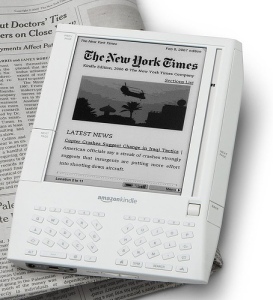
Take the Kindle for example. There was talk a while ago about a number of newspapers teaming up to offer subscriptions on Kindle. Not a bad idea. But the Washington Post’s executive editor said something that I found disconcerting:

You can subscribe now to The Post and a number of other newspapers on Kindle. We’re intrigued by the possibility of reaching a large audience through such hand-held readers, although so far the number of people who are reading The Post on Kindles is relatively small.

When I read this, I thought: Why does it matter how small the audience is? There’s obviously an audience. It might not be huge, but it’s how these people want to read your publication. News organizations are not in the position to be shedding readers because they don’t provide their content in the ways that their readers want to read it.

kindle

There aren’t that many options right now, so it isn’t inconceivable to have all of those bases covered. Some bases:

  • A developer platform. Be in contact with these developers. Who knows, one of them might write an application that could change your business.
  • Many, many Twitter accounts. In addition to each writer, have it for each section
  • Digg accounts
  • FriendFeed accounts (actually manned by someone)
  • Facebook accounts (maybe two – one “profile” and one “fan page”)
  • Podcasting
  • Vidcasting
  • Kindle publishing
  • Functional mobile Web application
  • Possibly a freesheet once a week at places people congregate (concerts, parks, etc)
  • Google Reader account, to let people know what writers/editors are reading. Mixture of your own content and from others

That’s just some of it. Things are changing every day. But you’ve got to be pushing your content, your brand, your writers – everything. You’ve got to be everywhere.

Your readers will decide how they want to read your content. It’s not for you, the news organization, to decide. If you don’t give your readers the content they want, in the way they want it, then they’ll look elsewhere for it.

Filed under: design, newspaper websites, social media , , , ,

Perspective is important

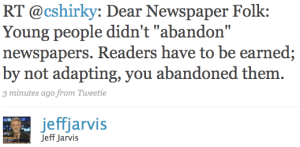
For newspaper executives the world over, this should qualify as an “ah-ha!” moment:

Twitter3

This is what runs through my mind when I read on Facebook or Twitter, journalists pleading/guilting/etc their friends and/or colleagues into buying a newspaper. Newspaper as a medium is not sacrosanct, much to the chagrin of every member of the Newspaper Association of America and most newspaper editors.

I doubt newspapers, the physical product, will go the way of the Dodo any time soon. They still have a purpose. In London millions of people read the numerous free dailies that are handed out each morning and evening.

They read it, put it down, and someone else picks it up. The digital readers like Kindle have a long ways to go before they dominate that set of consumer group, so until then it will be newspapers. And in some communities, newspapers are still preferred. But they’re fading.

But seeing people who don’t  buy newspapers as people who “abandoned” newspapers is a very wrong way of looking at it. Newspapers don’t own their readers. They can try to imagine some sense of reader loyalty, but that’s mostly imagined.

Filed under: community journalism, newspaper websites , ,

The case for “messy experimentation”

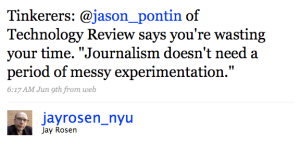
A few days ago a peculiar Tweet from NYU journalism professor Jay Rosen popped up in my Twitter feed.

Twitter

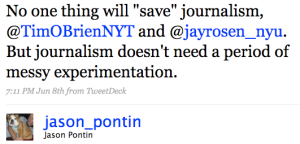
This gave me some pause. I thought, “Really? Journalism doesn’t need experimentation?” Surely Jason Pontin can’t be serious. But no, that’s really what he said.

Twitter2

Experimentation is the mother of invention, or something like that. Right? I hate to use Google as an example of experimentation gone right, but, well, that’s really what they are.

To illustrate my point, I suggest reading this fascinating piece in  The Huffington Post by Daniel Sinker,  journalism faculty member at Columbia College.

The kicker: Five years ago, Google’s entire revenue was a scant $3 billion. Newspapers’ print ad sales for 2004? $48.2 billion. And yet, with significantly smaller revenues, over that five year window, Google launched or acquired 35 products.

Each of those 35 products constitutes “messy experimentation.” I can’t imagine the people at Google thought, prior to launching Picasa, that it would take off. With every launch there’s a sense of “this might work, it might not.”

Journalism as a craft isn’t going anywhere. The industry, however, will continue to fall apart. We’ll probably see more big titles fall before this is said and done. There aren’t any investors rushing to the side of newspapers, mostly because they aren’t seen as being innovative, dynamic products. Some have begun to turn the corner and see themselves as not being immune to the economic situations and technological preferences of their readers.

But for the time being, experimentation will be the only way to really learn what works and what doesn’t. Otherwise we’re just treading water. Barely.

Filed under: newspaper websites, social media , , , ,

A new brand of hyperlocalism

This post adds to the topics touched on in the previous blog post about knowing your community’s bloggers and making use of them. What I’d like to talk about now is the evolution of hyperlocalism and the role of New Media and the Internet in it.

On top of the many ills that the newspaper industry current suffers from, one that I’m interested in analyzing is how small titles over time pulled back from its readers and enforced a ‘one-way-street’ mentality with the news.

The ‘one-way-street’ approach is very print-oriented. A press release rolls in, a few calls are made, a story is written, edited, and put in the paper. Titles have grown very accustomed to throwing news at their readers and hoping it sticks.

In a sense it suggests that the title knows whats best for its readers inherently, and is thus giving it to them without actually asking.

The Internet has changed that. News is a two-way street — especially hyperlocally. Titles should represent the community that they cover, while at the same time evolving with what their readers’ wants and needs are.

What I’m suggesting is a new approach to hyperlocalism. The idea of giving a community more of a stake in covering itself and letting its voice be heard. You do this, at a base level, by knowing every single important person on your beat. You then ask each of these important people if they would be willing to write blog posts detailing the goings-on of their areas. You’re giving them a voice.

Stay in touch with these people regularly. Ask them if they’ve had any ideas for blog posts. Then have them pitch it to you. This is a somewhat radical concept, but I think it’s important. Your community — your readers — should be pitching stories to you. You do this by setting up a group of well-known community members as pitchmen (and women).

You’ve got to give the community a stake in its coverage. Pass some of the onus onto them. The best way to get the community involved and caring is to let them, in a way, cover themselves.

I’m not suggesting this works at every level of the publication. What I am suggesting is that it would likely give the community a greater sense of ownership over a title that is supposed to be representing them and giving them the news that they want and need to know.

The Internet makes this possible and I believe it’s a direction that titles should seriously consider taking, first at an experimental stage and then, depending upon its success, pursuing it further.

It’s refined citizen journalism. These people aren’t journalists by trade. But they do have valuable information and are considered important people in the community. Not giving them a platform would be a mistake.

Filed under: community journalism, newspaper websites , , ,

Know your community bloggers

Blogging is pretty widespread. While I wouldn’t quite call it ubiquitous, it’s getting there. Despite that it’s fair to say that most every community in the US likely has a blogger or two sitting in homes clacking away about what’s happening with them in their community.

In the age of Web-first and community involvement, these kinds of people are extremely valuable. Titles need to know who the bloggers are in their communities. If the blogger is good, offer them a platform to write on a specific subject. Money is tight, but I believe that many would be happy to have the platform and to be recognized as an authoritative voice in their community on a specific subject.

It’s often as easy as keyword searching locations and landmarks in your coverage area into Google’s blog searcher. This will give you an index of instances where these locations have been mentioned in blogs. Half the work is already done for you.

If there’s a college in your area that has a journalism program, you should be walking into those classrooms and asking for applicants who consider themselves good bloggers. These students are looking for ways to add experiences to their portfolios and the students looking to get ahead will see this as a prime opportunity.

Community and hyper-local journalism is going to need to return to the community to rebuild its reputation and standing. This is a perfect opportunity to involve the community, learn more about your readers and increase the amount of content you’re putting online.

Filed under: newspaper websites, social media, student journalism , , , , ,

The revolution will be aggregated

The news industry is in the midst of the Digital Revolution. It’s not a secret, but occasionally it needs to be said as some — most recently, The Associated Pressseem to forget.

A major part of this revolution is the rise in prominence of content aggregators. If you think about it, news aggregators have been around for a while. They started as RSS feeds. You could put them into readers, such as Google Reader or Feed Burner, and get the news delivered to you. Some browsers even come pre-packaged with a news aggregator in the upper-left corner in a drop-down format.

What’s changed now is that aggregators now have a fancy face and greater interactivity. Many, many people still use standard RSS feeds, but that hasn’t stopped the evolution of the aggregator.

Some of the most popular news sites on the Web are at least part-aggregator. Examples of this: The Huffington Post, Wonkette, Drudge Report, Gawker, and on and on.

The new news consumer can’t be bothered to find the news they’re interested in. They want it at their doorstep. And then once its on their doortep, they want someone to read it for them and pull out the interesting parts and spread them out on the table for them.

What this means is over the next few years regional and local news aggregators will sprout up and they will gain prominence. What this means is that local news outlets, instead of being the place people go for content, will instead become small AP-like outlets that supply content to aggregators. The second part of that I don’t expect to happen for a number of years. Not until local and regional aggregators have firmly asserted themselves.

But once they do, look out. It will be a game-changer.

Filed under: Aggregation, community journalism, newspaper websites, social media , , , ,

Why newspaper Web sites are catered to print readers and the problems it causes

I’m currently doing  a work experience stint with The Daily Telegraph, working on their Web site, telegraph.co.uk. I had a conversation yesterday with the editor of the site about the design. I asked if perhaps the blogs should be more prominent.

He agreed with what I was saying, but we weren’t able to come away with a solid solution. Perhaps over the next few weeks one will emerge. The most interesting thing that came up in our chat was the suggestion that The Telegraph’s site — and the sites of many other newspapers — are designed with the intention of it mimicking the print product.

Data shows that the people who are consuming news on the Web are younger than those who turn first to print. Why, then, are newspaper Web sites designed as digital versions of the print product?

I realized the answer as soon as I asked it: People who consume news on the Web don’t visit the sites themselves. They’re linked in through aggregators and feeds. Often they don’t have to navigate the site because the content they want is delivered right to to them.

What we have is a viscious circle that has the potential for stifling creativity and the evolution of Web news. But it also poses a problem. The data says one thing, but it also says something to contradict it. The industry demands that you have a solid Web site, but the market shows young people like their news highly customized. That often means making the news come to them, not the other way around.

I don’t have a solution for this, but I wanted to get it down while it was fresh in my mind. It’s a strange position to be in. Undoubtedly aggregators will continue to grow and become more widespread. What that means for the actual Web sites of news organizations remains to be seen.

Filed under: Uncategorized

J-school & Web development: A perfect match

An interesting article was floating around Twitter a few days ago. It appeared in Editor & Publisher and was written by Seth Porges, who is currently an editor at Popular Mechanics magazine.

The subject he addressed was whether j-schools are adequately preparing students for the real world – and in it suggesting they’ve misstepped.

His thesis statement is that j-schools are too quick to adopt new media standards, such as basic Web coding, and are in the process throwing out pre-existing elements of core curriculum that should remain.

In this blog post I take chunks of what Mr Porges said, and give my thoughts and opinions.

Read the rest of this entry »

Filed under: design, newspaper websites, social media, student journalism , , , , ,

About Me

My Tweets

Top Clicks

  • None

Blog Stats

  • 2,818 hits


July 2009
M T W T F S S
« Jun    
 12345
6789101112
13141516171819
20212223242526
2728293031